
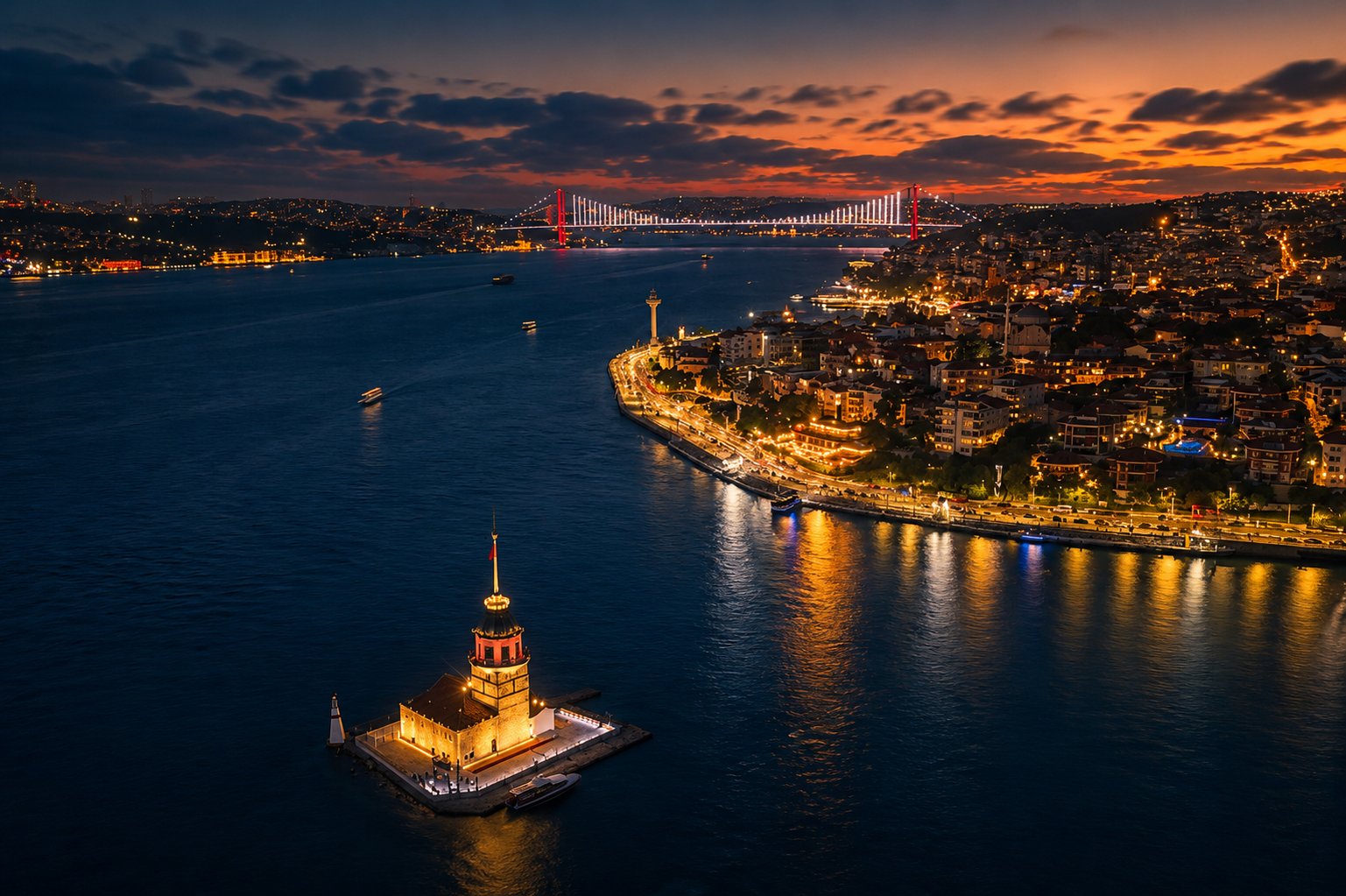
I have crossed the Bosphorus at every hour of the day, in every season, for years. Mornings have their own clarity, and a midday run gives you the strait at its most energetic, with ferries and tankers and fishing boats all working at once. But if a guest asks me for the single best window to be on the water, I never hesitate. It is the hour before the sun drops behind the European hills.
There is a reason the light at that time feels different here, and it is not just romance. Istanbul sits where two continents nearly touch, and the water acts like a long mirror laid between them. As the sun lowers, that mirror turns the whole strait gold, then copper, then a deep blue that swallows the shoreline. The palaces along the banks were built to be seen from the water, and at sunset they finally look the way their architects intended.
This is a quiet argument for slowing down. Most visitors treat the Bosphorus as a box to tick. Done properly, at the right hour, it becomes the part of the trip people talk about for years.
The Quality of the Light
Photographers call it the golden hour, but on the Bosphorus it behaves in a particular way. The strait runs roughly north to south, so as the sun sets in the west it rakes across the water at a low angle and lights the eastern, Asian shore directly. Buildings that look ordinary at noon suddenly glow. The marble of the old palaces warms up. The minarets catch the last light long after the streets below have fallen into shadow.
Then the colour shifts quickly. You get perhaps forty minutes of real change, from bright gold to soft pink to the blue hour, when the sky and the water seem to share the same tone and the city lights begin to switch on one by one. Being on a boat during that transition, rather than watching it from a fixed point on land, means the scene keeps rearranging itself around you.
What You See From the Water
From the deck you read Istanbul in a way no street can offer. The shoreline becomes a single continuous story of empire, defence, and modern life, and at sunset each piece of it is lit in turn.
Dolmabahce and Ciragan
Leaving the lower Bosphorus you pass Dolmabahce Palace, the grand European-style residence the late Ottoman sultans moved into when Topkapi felt too old-fashioned. Its long white facade was designed to impress from the sea, and in evening light the gilding really does shine. A little further up, Ciragan Palace, now a hotel, carries the same imperial confidence along the waterline.
Rumeli Fortress
Higher up the European bank stands Rumeli Hisari, the fortress Mehmed the Conqueror built in 1452 to control access to the city before the conquest. It was raised in a matter of months at the narrowest point of the strait. Seen from the water at dusk, its towers and curtain walls climbing the hillside give you the clearest possible sense of why this crossing was always about control.
The Two Bridges and the Maiden's Tower
You pass beneath the great suspension bridges that link Europe and Asia, and as the light fades their cables begin to glow with colour. Down near the mouth of the strait sits the Maiden's Tower on its tiny island, lit and floating, the small landmark that anchors almost everyone's memory of the view.
How the Scene Changes Across the Crossing
One of the things I try to prepare guests for is that the Bosphorus is not a single view. It changes character every few minutes. The lower stretch near the old city is busy and monumental, all palaces and ferry traffic. As you move north the banks soften into wooden waterfront mansions, the yali houses that wealthy families have kept for generations, and the hills grow greener.
At sunset this progression has a rhythm. The grand stone facades catch the early gold, then as you turn back the same buildings are seen against a darkening sky with their own lights coming on. You effectively get two versions of the strait in one short cruise, and the return leg is often the more beautiful of the two.
Before You Go
Timing Your Sunset on the Water
- Aim to board roughly an hour before official sunset, which shifts significantly between summer and winter, so check the date rather than assuming a fixed time.
- Summer sunsets here can fall close to 8:30 in the evening, while in midwinter the light goes by mid-afternoon. Plan dinner around it accordingly.
- Bring a light layer even in warm months. The wind funnels down the strait and the temperature drops noticeably once the sun is gone.
- Sit or stand on the starboard side heading north for the best run of palaces, then move across for the city skyline on the way back.
- A private cruise lets you set the departure to the exact light rather than a fixed schedule, which matters more here than almost anywhere else.
- Keep your phone or camera ready for the blue hour, the ten minutes after the sun has gone when the sky and water match and the city lights come up.
Common Questions
Questions and Answers
Is sunset really better than a daytime Bosphorus cruise?
For most visitors, yes. Daytime offers clearer detail and is good if you want strong photographs of specific buildings, but sunset gives you the light, the colour shift, and the city lights coming on, which is the experience people tend to remember.
How long does a Bosphorus sunset cruise take?
A focused private cruise usually runs between one and a half and two hours, which is enough to reach the upper palaces and fortresses and return as the lights come up.
Will I actually see the main landmarks clearly?
Yes. The route passes Dolmabahce, Ciragan, Rumeli Fortress, both intercontinental bridges, and the Maiden's Tower, all visible from the water and lit attractively in the evening.
What is the best time of year for a sunset cruise?
Late spring and early autumn are ideal, with mild evenings and long, soft light. Summer is beautiful but warm and busy, and winter sunsets are dramatic but cold and early.
Can the cruise be timed to the actual sunset?
On a private cruise, yes. Because sunset shifts through the year, we set the departure to the specific date so you are on the water for the best part of the light.