
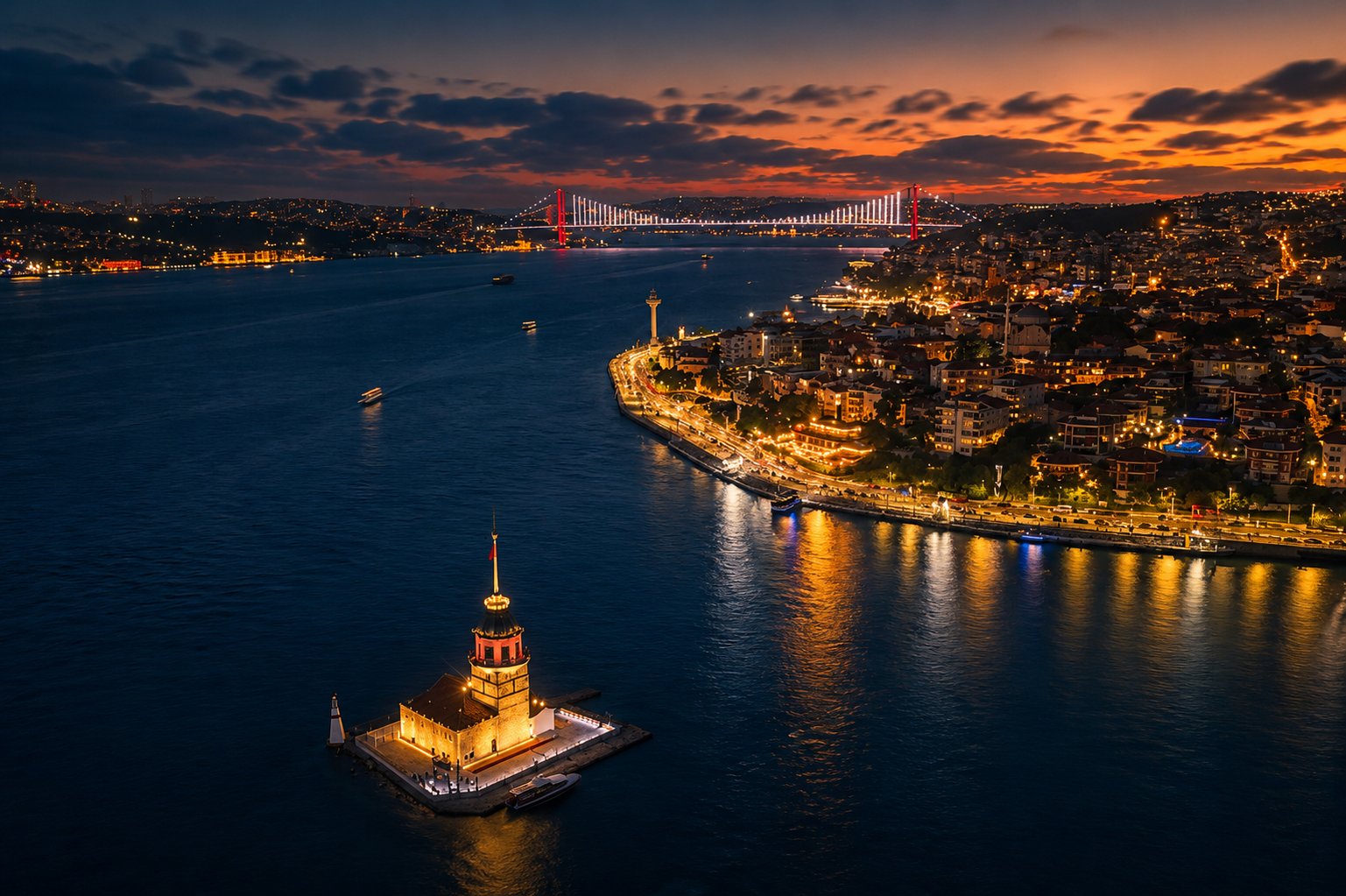
A first visit to Istanbul tends to be disorienting in a way that few other cities manage. The sheer scale of the place catches people off guard. The sensory layering of calls to prayer, ferry horns, market noise and construction sounds. The physical contrast between the sweeping Byzantine dome of Hagia Sophia and the intimate carved stonework of a nearby Ottoman fountain. The discovery that the city spreads across two continents, separated by a waterway that has been one of the world's most contested passages for three thousand years. Istanbul is genuinely a lot to take in, even before you start making decisions about what to do first.
Most first-time visitors make the mistake of trying to plan their way out of that overwhelm by building a list of as many sites as possible. The result is usually a day that feels like a race. The antidote is a clear priority order and enough time at each stop to actually understand what you are looking at. This guide gives you that order.
Begin on the Historic Peninsula
The Historic Peninsula, the triangular landmass bounded by the Golden Horn to the north, the Sea of Marmara to the south, and the old Byzantine land walls to the west, is where Istanbul's most significant monuments are concentrated. It is also where the city's identity was formed. This was Constantinople, the capital of the Byzantine Empire for over a thousand years before the Ottoman conquest in 1453. After the conquest, it became the seat of the Ottoman sultans and the centre of an empire that stretched from Vienna to Baghdad.
Everything that matters most to a first-time visitor is here: Hagia Sophia, Topkapi Palace, the Basilica Cistern, the Hippodrome, the Blue Mosque and the Grand Bazaar. The neighbourhood of Sultanahmet, which sits at the heart of the peninsula, is compact enough to walk between most of these sites, though the distances and the hills involved are often underestimated. Starting here is not just the most logical choice. It is the only choice that makes sense for a first visit.
The Four Landmarks Every First Visit Should Include
Istanbul has dozens of sites that reward serious attention. On a first visit, four of them are essentially non-negotiable. Not because they are simply the most famous, but because each one tells a part of the city's story that nothing else tells as clearly.
Hagia Sophia
There is no more important building in Istanbul. Completed in 537 CE under the Byzantine Emperor Justinian I, it was for nearly a thousand years the largest cathedral in the Christian world. When Mehmed II rode into the city in 1453, he converted it into a mosque on the day of the conquest, an act of deliberate symbolism that announced the transfer of the world's great imperial power. It was a museum for most of the twentieth century and has been a working mosque again since 2020. Whatever your feelings about that change, the building itself remains staggering. The dome, which appears to float on a ring of light above the nave, was an engineering feat that pushed the limits of sixth-century material science. Stand under it for long enough and you begin to understand why visitors to Byzantine Constantinople described it as suspended from heaven by a golden chain.
Topkapi Palace
The administrative and residential heart of the Ottoman Empire from the 1460s until the mid-nineteenth century, Topkapi is less a palace in the European sense and more a city within a city. It is organised around a sequence of courtyards, each more restricted in access than the last, with the most private spaces at the centre. The Harem, the Treasury, the Chamber of the Sacred Relics: each rewards careful attention. The view from the fourth courtyard, over the confluence of the Bosphorus, the Golden Horn and the Sea of Marmara, is one of the most layered panoramas in any city on earth. Allow at least two hours, and more if you plan to visit the Harem separately.
Basilica Cistern
Built in the sixth century to supply water to the Great Palace of Constantinople, the Basilica Cistern was forgotten after the Ottoman conquest and rediscovered by a French traveller in 1545, who found local residents fishing through holes in their floors into an underground lake. The cistern covers nearly ten thousand square metres, supported by 336 marble columns arranged in rows twelve deep. At the far northwestern corner, two column bases rest on carved Medusa heads, positioned sideways and upside down, in a gesture that has generated argument among scholars for centuries. It is one of the more quietly unsettling spaces in the city, and deeply worth the forty-five minutes it takes to walk through properly.
The Grand Bazaar
Built in the fifteenth century, the Grand Bazaar is not simply a market. It is an Ottoman commercial institution, a covered city with over four thousand shops, its own internal geography, its own logic and its own social codes. The first-time visitor usually enters feeling slightly assaulted and exits feeling they have missed something. Going with someone who knows the building changes the experience entirely. The bedesten at the centre, where the most valuable goods were historically kept and still the architectural heart of the complex, is worth finding. So are the hans, the caravanserai-style merchant inns attached to the bazaar on its outer edges, where artisans still work in trades that have occupied the same buildings for centuries.
The Order Matters More Than You Think
Start at Hagia Sophia, early. The queues build quickly and the interior is at its most atmospheric in the morning light that enters through the high windows on the southern side. From Hagia Sophia, cross to the Basilica Cistern before the midday rush. Then Topkapi Palace, allowing the afternoon for its courtyards and the quieter rooms of the Treasury. Save the Grand Bazaar for late morning or early afternoon if you want to see it properly, as it closes earlier than most visitors expect. This sequence follows a loose geographical logic that reduces unnecessary backtracking, and it also moves from the most emotionally charged sites to the more commercially lively ones, which tends to feel more satisfying than doing it the other way around.
What First-Time Visitors Consistently Underestimate
Two things surprise almost everyone. The first is how much there is to understand at each site beyond its visual impact. Hagia Sophia is not simply a large beautiful building. It is a document of imperial theology, of political power, of the relationship between the Christian and Islamic traditions over fifteen centuries. Without context, you see the dome and the mosaics and leave impressed. With context, you leave changed. That difference is what a good guide provides.
The second thing people underestimate is the walking. The Historic Peninsula looks manageable on a map but is covered in hills, and the distances between sites are longer than they appear. Most visitors cover six to eight kilometres on foot during a full day in Sultanahmet, across uneven cobblestone streets that are demanding on the feet. Comfortable shoes are not optional. Neither is water, particularly in the summer months when temperatures in July and August frequently exceed thirty-five degrees.
When to Visit and How to Avoid the Worst Crowds
April, May, September and October are the best months for a first visit. The temperatures are moderate, the light is good for photography, and the crowds, while significant, have not yet reached the peak-summer intensity that makes Hagia Sophia and Topkapi Palace feel genuinely uncomfortable on busy days. July and August are the most visited months and also the hottest. If you must visit in summer, start every day as early as possible and plan quieter activities for the middle of the afternoon.
Within any given day, being at the entrance to Hagia Sophia before 9 am makes a tangible difference. The same is true of Topkapi. By 11 am, both sites are at or near peak capacity on most days between May and October. Pre-booking tickets online eliminates the queue entirely and is worth the small additional cost.
Practical Notes
- Book tickets for Hagia Sophia and Topkapi Palace online in advance. Long ticket queues form from mid-morning onwards during peak season and can cost an hour of your day.
- Hagia Sophia is an active mosque. Dress modestly: shoulders and knees covered for all visitors, and women should carry a headscarf. Shoes are removed at the entrance. This applies regardless of your purpose for visiting.
- Wear comfortable shoes with good support. The Historic Peninsula's cobblestone streets are uneven and the distances between sites are greater than they look on most tourist maps.
- Cash is useful for small purchases in the bazaar area and at some food stalls, but major sites and most restaurants now accept card. Inform your bank of your travel plans before arriving.
- Aim to arrive at Hagia Sophia by 9 am and at Topkapi no later than 10 am to see the most-visited rooms before the midday crowds arrive. The Cistern is less crowded in the early afternoon.