
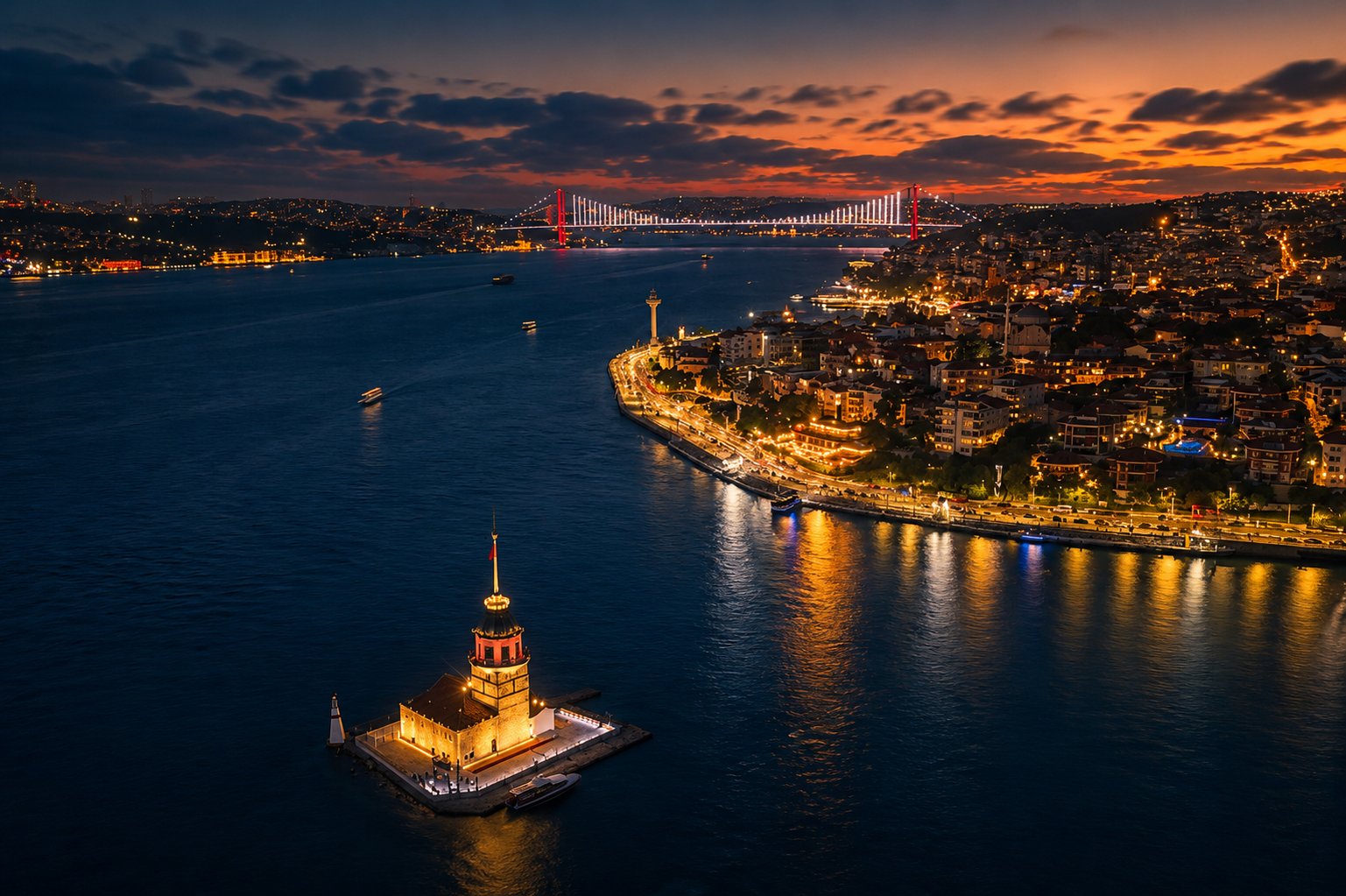
There is a version of Istanbul that almost every visitor sees: Hagia Sophia, Topkapi Palace, the Blue Mosque, the Grand Bazaar. These are extraordinary places and they deserve the attention they receive. But the version of the city that stays with you long after the photographs have faded is not the famous skyline from a tourist terrace. It is the Istanbul that requires a little more effort to reach: the underground spaces, the walls no one photographs, the neighbourhoods where the city's social memory is still physically present in crumbling plaster and surviving iron grilles.
The argument for going further is not simply novelty. It is accuracy. The famous monuments give you the heights of what Istanbul has been. The lesser-visited layers give you the texture, the complexity, and the full span of time that the city has passed through. Both are necessary for understanding the place as it actually is.
The Istanbul That Most Visitors Miss
Most itineraries for Istanbul are shaped by the tour-bus logic of famous names and obvious landmarks. Nothing wrong with that as a starting point. But Istanbul is a city that has been continuously inhabited for more than two and a half millennia, and the accumulation of all that time does not compress neatly into a list of ten monuments. It spreads into the street patterns, the water infrastructure, the traces of walls that were built to keep out Avars or Crusaders or Bulgars. It hides in the foundational stones of buildings whose upper floors were rebuilt four or five times. It persists in neighbourhood names that preserve the memory of communities that no longer exist.
Finding these layers requires knowing where to look and, more importantly, knowing what you are looking at when you find them. The physical evidence is often subtle. A pattern of stones in a wall that indicates a Byzantine repurposing of earlier Roman material. A doorway in an otherwise unremarkable street that opens onto a courtyard built by Armenian merchants in the eighteenth century. A stretch of crumbling brickwork visible from a bus window that represents one of the finest surviving examples of late antique military engineering in the world. Context is everything. Without it, the hidden Istanbul is simply difficult to reach. With it, it becomes the most interesting version of the city available.
Underground: Cisterns, Dungeons and Forgotten Foundations
Istanbul sits on top of a vast and largely invisible hydraulic infrastructure built to supply a city that, at its Byzantine peak, may have housed half a million people. The challenge of feeding that population with fresh water, in a city surrounded on three sides by saltwater, was solved through an elaborate system of aqueducts bringing water from Thrace and a network of underground cisterns storing it within the city walls. Dozens of these cisterns survive beneath the streets of the Historic Peninsula. Most are inaccessible. A handful have been opened to the public in various states of restoration. Two of them deserve serious attention.
Basilica Cistern (but not how most people see it)
The Basilica Cistern is one of the most-visited sites in Istanbul, which means it is usually experienced as part of a moving queue in half-light, with limited opportunity to stop and examine what you are actually looking at. Visited with a guide who knows the space, it becomes something different. The 336 columns supporting the vaulted brick ceiling are not uniform: they were collected from across the Byzantine world, reused from earlier structures, and placed without concern for matching their capitals or proportions. This was standard Byzantine practice, a form of architectural recycling that speaks volumes about the empire's relationship to its own classical past. At the far end of the cistern, two column bases rest on Medusa heads, one inverted, one placed sideways. These have generated more scholarly argument than almost any other detail in the city. No consensus exists on why they were positioned this way. A guide can tell you what the competing theories are, which is more useful than a sign that simply identifies them without explanation.
Binbirdirek Cistern and the lesser-known underground
Binbirdirek, which translates loosely as "a thousand and one columns," was built in the fourth or fifth century CE and is the second largest surviving Byzantine cistern in Istanbul. It was used as a textile workshop for centuries after the Ottoman conquest and is still partially filled with the accumulated debris of that period. The columns, which were originally taller than they now appear, were shortened at some point to accommodate the industrial use of the space. It is less polished than the Basilica Cistern and considerably less visited, which makes it easier to understand as a piece of engineering rather than a tourist attraction. Several other cisterns in the Sultanahmet area are accessible on request, and the network of Byzantine foundations visible beneath the foundations of Ottoman buildings in the area is considerable, if you have someone with you who knows where to look and how to read what you find.
The Byzantine Walls and What They Mean
The Theodosian Walls, built between 408 and 413 CE under the regent Anthemius and the young emperor Theodosius II, are among the most significant surviving works of late antique military engineering anywhere in the world. They stretch for roughly six and a half kilometres from the Sea of Marmara to the Golden Horn, enclosing the Historic Peninsula on its landward side with a triple line of walls, towers and a moat. They held for over a thousand years. They were breached definitively only once, on 29 May 1453, after a siege that lasted fifty-three days.
Most visitors to Istanbul never see them at all. They lie several kilometres west of Sultanahmet, in a part of the city that does not appear on most tourist maps. The walk along the surviving sections is both melancholy and revelatory. You can read the repairs made after the 1453 assault in the Ottoman brickwork patching Byzantine stonework. You can see the gate through which Mehmed II's army entered the city. You can stand on the parapet of a tower that looked out over the same landscape in the fifth century. The walls are not a museum. They are the city's edge, still physically present, still defining the perimeter of what was once the most important urban space in the Christian world.
Chora Church and the Western Districts
The Chora Church, now officially the Kariye Mosque, stands near the Edirnekapı gate in the Theodosian Walls, several kilometres northwest of Sultanahmet. It was the funerary church of the Byzantine aristocracy and was decorated in the early fourteenth century under the patronage of the statesman Theodore Metochites with the finest mosaic and fresco cycle to survive from Byzantine civilisation. The mosaics depict the life of Christ and the Virgin Mary in a narrative programme of unusual psychological depth. The frescoes in the side chapel, showing the Anastasis, or Resurrection, are considered by many Byzantine scholars to be the most accomplished religious paintings produced before the Italian Renaissance.
The church was converted to a mosque in the early sixteenth century and the mosaics were plastered over, which paradoxically preserved them. They were uncovered during restoration work in the 1940s and 1950s and are in remarkable condition. The building has recently been reconverted to active mosque use, which affects some aspects of access, but the mosaics remain visible. Getting there from Sultanahmet requires either a taxi or a combination of tram and walking, and the neighbourhood around the church is worth exploring in its own right: it is one of the oldest continuously inhabited parts of the city, and its character is entirely different from the tourist-oriented streets of central Sultanahmet.
Balat, Fener and the Layered Neighbourhoods
The districts of Balat and Fener, on the southern shore of the Golden Horn to the northwest of Sultanahmet, represent a different kind of hidden Istanbul. This is not a matter of underground archaeology or surviving ancient walls. It is a matter of social history compressed into urban fabric. Balat was for centuries one of the main Jewish quarters of the city, home to Sephardic communities expelled from Spain in 1492 and resettled in the Ottoman Empire by invitation of Bayezid II. Fener was the centre of Greek Orthodox life, home to the Ecumenical Patriarchate, which still operates there from a low-key complex of buildings on a steep street above the water.
Both neighbourhoods have gentrified significantly in the past decade, but enough of the older fabric survives to make the demographic layering still legible. You can walk from a synagogue to a Greek Orthodox church to a mosque within five minutes. You can see nineteenth-century Jewish merchant houses alongside Armenian churches and Ottoman hans. The neighbourhood's social history, the expulsions, the pogroms, the population exchanges of 1923, the events of 1955 that drove most of Istanbul's remaining Greeks from the city, is dense and often painful. A guide who knows how to handle that history is essential for understanding what you are walking through.
What a Guide Changes in These Places
The practical argument for having a guide in these less-visited parts of Istanbul is simple: many of the relevant sites are difficult to find, some require permissions or specific visiting hours that are not published online, and several are entirely invisible without someone who knows where to look. But the deeper argument is interpretive. The hidden layers of Istanbul are hidden partly because they require knowledge to decode. A stretch of Byzantine wall looks like a stretch of old wall without context. With context, it becomes a legible document of political and military history. The Medusa heads in the Basilica Cistern look like curious decoration without context. With context, they open onto the entire question of how Byzantine civilisation related to its classical inheritance. Context transforms observation into understanding, and that transformation is what a good guide provides.
Practical Notes
- The Theodosian Walls and the Chora Church are four to six kilometres from central Sultanahmet. Budget transport time and consider combining both in a single westward excursion rather than making separate trips.
- The Chora Church has recently returned to active mosque use. Check current access arrangements before visiting, as prayer times affect the areas available to non-worshipping visitors.
- Balat and Fener are best explored on foot. The streets are steep and cobbled. Allow at least two hours for a proper walk through both neighbourhoods, more if you want to stop at the Patriarchate or any of the synagogues.
- Some of Istanbul's lesser-known cisterns and underground spaces can only be visited through pre-arranged access. A specialist guide can make these arrangements in advance as part of a customised itinerary.
- The best time to visit the Theodosian Walls is mid-morning on a weekday, when the traffic on the road running alongside them is lighter and the light on the stonework is at its clearest.