
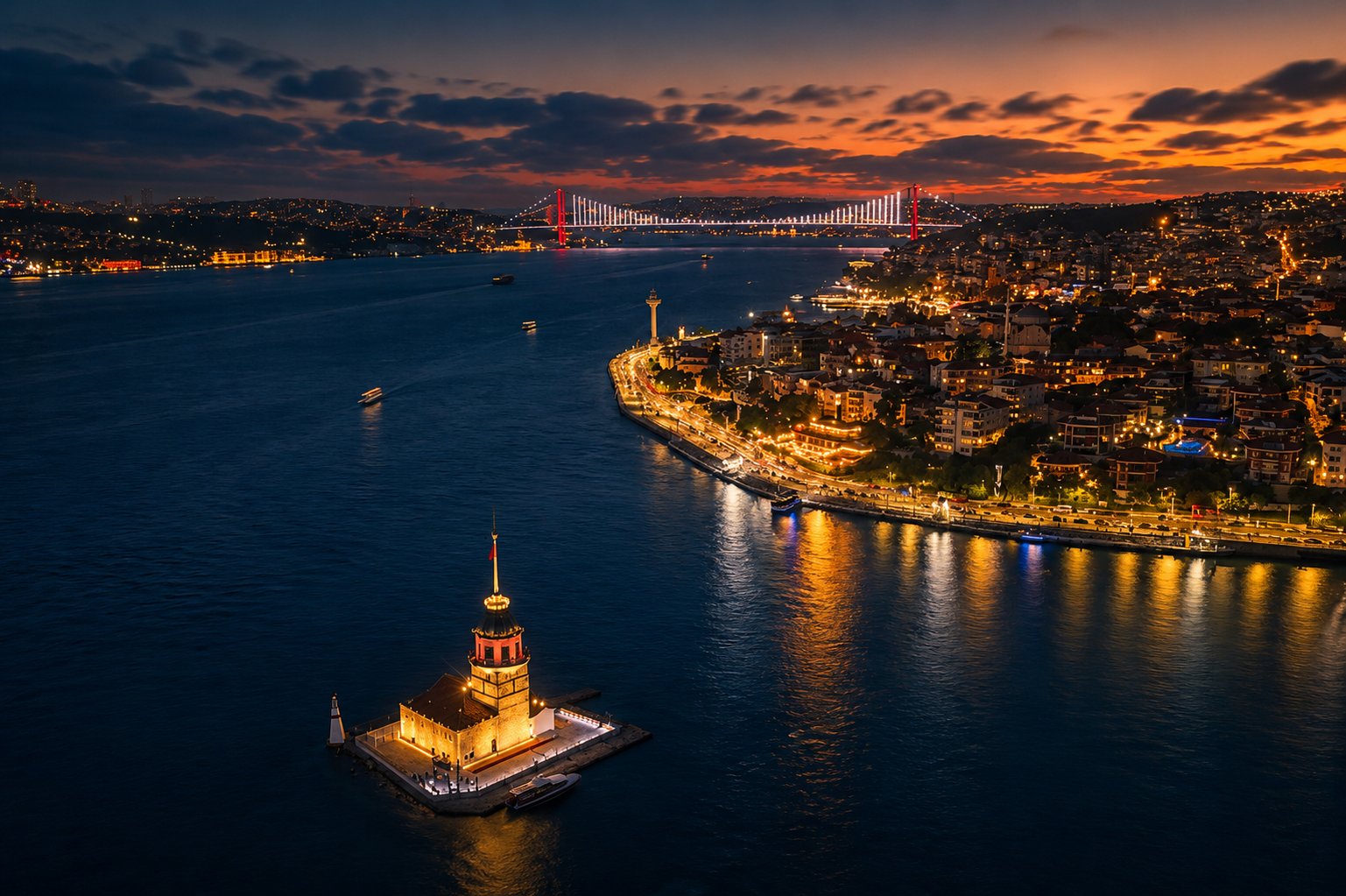
Istanbul is unusual among world cities in that it contains not one but two fully realised imperial civilisations, layered one on top of the other in the same streets, the same buildings, and sometimes the same walls. You can stand in a single room and see Byzantine mosaic work above you and Ottoman calligraphy beside you. You can walk from a church built in the fourth century to a mosque commissioned in the sixteenth and understand, if you know what you are looking at, how one world gave way to the other without either disappearing entirely.
This creates a genuine question for visitors who want to approach the city seriously: which story do you follow? The Byzantine narrative is long, complex and ultimately tragic. The Ottoman narrative is equally long, more materially intact, and built on the ruins of what came before. Understanding how they relate is the key to understanding Istanbul itself.
Two Cities, One Location
When Constantine I established Constantinople as the new capital of the Roman Empire in 330 CE, he was building on a site already occupied by the Greek colony of Byzantium, founded around 660 BCE. The location was chosen with strategic clarity: it commanded the Bosphorus, controlled trade between the Black Sea and the Mediterranean, and was naturally defensible on three sides by water. For over a thousand years, this geography made Constantinople the wealthiest and most powerful city in the Christian world.
When Mehmed II took the city on 29 May 1453, he did not simply conquer a capital. He inherited a civilisation and made a series of deliberate choices about what to preserve, what to convert, and what to build fresh. The Ottoman city that grew over the next three centuries was not a replacement of Byzantine Constantinople so much as a radical transformation of it, reordering the same geography around new theological, political and aesthetic principles while leaving enough of the original fabric intact to remain readable by anyone who knows how to look.
The Byzantine City: Constantinople (330-1453)
Byzantine civilisation is harder for most Western visitors to access intuitively than Ottoman civilisation. It is geographically Eastern but theologically descended from Roman Christianity. Its art follows rules that look unfamiliar at first: flat, frontal, intensely symbolic, deliberately uninterested in the naturalistic representation that Western audiences associate with religious painting. Its architecture reaches for the dome in ways that Roman buildings never quite managed, using sophisticated pendentive construction to float enormous masonry structures above unexpectedly light interiors. Once you develop a feel for its logic, Byzantine art and architecture become deeply compelling. But the learning curve is real.
What survives from Byzantine Constantinople
Less than most people assume, but more than most visitors find. The most important surviving structure is Hagia Sophia, which stands essentially as Justinian's architects left it in 537 CE, its dome raised, its interior still carrying fragments of the original mosaic programme alongside later Byzantine additions from the ninth through fourteenth centuries. The Chora Church, in the Edirnekapı neighbourhood well west of Sultanahmet, preserves the finest surviving Byzantine mosaic cycle in the world, dating from the early fourteenth century. The Hippodrome retains its original street plan and three of its ancient columns. The Theodosian Walls, built between 408 and 413 CE, still stand in substantial sections along the western edge of the Historic Peninsula. Underground, the Basilica Cistern survives intact and gives a vivid sense of the engineering infrastructure that kept the Byzantine city supplied with water. Several other cisterns, in varying states of accessibility, lie beneath the streets of Sultanahmet.
Hagia Sophia as the bridge between both worlds
Hagia Sophia is the one building in Istanbul that genuinely belongs to both civilisations. It was the most important church in Christendom for nearly a thousand years. On the day of the conquest, Mehmed II converted it into a mosque, the single most symbolically charged act of his reign. He left the structure intact, covered or removed most of the mosaics, and added the Islamic features that now coexist with the Byzantine fabric: the massive circular calligraphic medallions, the minbar and mihrab, the four external minarets added by later sultans. The result is a building that is entirely itself: neither purely Byzantine nor purely Ottoman, but something that could only exist at this specific intersection of histories. Standing inside it with the full context of both traditions active in your mind is one of the more extraordinary intellectual experiences any building can produce.
The Ottoman City: Imperial Transformation (1453 onwards)
The Ottoman arrival was not a rupture. It was a continuation, conducted under new management and organised around a different theological framework. Mehmed II understood himself as the successor to the Roman emperors, not as their destroyer. He was twenty-one years old when he rode into Constantinople, and he spent the rest of his reign building an imperial capital that would rival, and ultimately exceed, anything the Byzantines had left behind.
What Mehmed II preserved and what he changed
Mehmed's first act in the conquered city was to walk to Hagia Sophia and convert it to a mosque. His second was to begin depopulating and then repopulating the city, which had shrunk dramatically from its Byzantine peak of perhaps half a million people to perhaps fifty thousand by 1453. He brought in craftsmen, merchants, scholars and administrators from across the empire, settling them in the depopulated districts around the Golden Horn and establishing the mixed community structure that would define Istanbul for the next four centuries. He preserved Byzantine churches in significant numbers, converting some and leaving others to the Greek, Armenian and Jewish communities he was actively encouraging to return. He commissioned the Topkapi Palace on the headland commanding the Bosphorus, deliberately siting his new imperial seat on top of the acropolis of ancient Byzantium.
The Ottoman monuments that define the skyline
The great mosques of the Ottoman period define Istanbul's silhouette in a way that nothing from the Byzantine era can match at a distance, simply because the Byzantines built inward and the Ottomans built upward, competing with and responding to the dome of Hagia Sophia in a centuries-long architectural conversation. The Suleymaniye Mosque, completed in 1557 by the architect Sinan under the commission of Suleiman the Magnificent, is architecturally the more accomplished of the great imperial mosques. The Sultan Ahmed Mosque, known internationally as the Blue Mosque, is more centrally located and more visited, but Sinan's work at the Suleymaniye represents the more resolved solution to the problem of building a great domed space that could stand comparison with Hagia Sophia without simply copying it.
How to Read a Building: Byzantine vs Ottoman
Byzantine architecture is built around the hierarchy of light. The dome floods its interior with natural illumination from windows at its base. The mosaic surfaces covering the walls and vaults are designed to catch and reflect that light, making the interior appear to glow from within. The theological intention is explicit: the church building represents the heavenly Jerusalem, the light of God made physically perceptible in stone and gold tesserae.
Ottoman mosque architecture works from a different set of principles. It is interested in geometric clarity, in the perfect resolution of structural forces, and in the experience of a unified interior volume rather than a hierarchically ordered one. The great Ottoman mosques feel different from Byzantine churches not because they have failed to achieve what Byzantine architects were attempting, but because they were attempting something fundamentally different. The interior of the Suleymaniye is cool, ordered, rational. The interior of Hagia Sophia is overwhelming and mysterious. Both are achievements, but of entirely separate kinds.
Which Focus Suits You?
If your interest is in the early Christian world, in the political theology of late antiquity, in the relationship between art and religious authority, or in the question of how a civilisation declines and what it leaves behind, then a Byzantine-focused visit will be deeply satisfying. You will need more specialist guidance to access this layer of the city, because the Byzantine material is less immediately legible to most visitors and requires context to become meaningful.
If your interest is in imperial architecture, in the mechanisms of power, in the visual culture of the Islamic world, or in the question of how a new civilisation builds itself out of the materials of one it has conquered, then the Ottoman layer is richer and, in some ways, more immediately accessible. The mosques are still in use. Topkapi Palace is exceptionally well preserved. The bazaar quarter still functions as an Ottoman institution.
If you are visiting for the first time and remain genuinely uncertain, start with the Classic Tour, which moves through both layers of the city and gives you enough of each to know which one you want to return for.
Practical Notes
- The Byzantine Heritage Tour and Ottoman Highlights Tour each require a full day to cover properly. Do not try to combine both into a single itinerary on your first visit.
- The Chora Church (Kariye Mosque) is in the Edirnekapı neighbourhood, about four kilometres west of Sultanahmet. It requires a dedicated visit and is best combined with a walk along the Theodosian Walls.
- Both Hagia Sophia and the Blue Mosque are active places of worship. Dress codes apply: shoulders covered, knees covered, shoes removed at the entrance to both.
- The interior mosaics of Hagia Sophia are best seen in morning light, when the sun enters through the southern windows of the upper gallery. Visit before 10 am for the clearest view and the smallest crowds.
- Pre-book tickets for Topkapi Palace and Hagia Sophia online. Queue times at both can reach one to two hours on busy summer days without advance booking.